News and views from the award-winning author of the novels The Skinny Years, America Libre, House Divided and Pancho Land

Saturday, December 10, 2011

The first time Bones said "This man's dead, Captain."

When did Deforest Kelley first say "This man's dead, Captain" onscreen? The answer may surprise you. 
Because it was not on Star Trek at all.


"This man's dead, Captain."

Whenever fans of the original Star Trek hear that line, they will forever remember Deforest Kelley who played Dr. Leonard McCoy on the show.

The line was used so often on Star Trek, it became part of a college drinking game back in the day. The rules were simple: While watching the show, every time a character said "Captain" or "Jim,"  each contestant would down a swallow of beer. Whenever McCoy said "This man's dead, Captain" or Spock said "Fascinating," contestants had to drain their glasses. There were no winners, really. The goal was to finish the show while still conscious.

When did Kelley first say "This man's dead, Captain" onscreen? The answer may surprise you. Because it was not on Star Trek at all.

I discovered the answer for myself while watching The Man in the Gray Flannel Suit, a few days ago. In a scene from a WWII Pacific battle, hero Gregory Peck brings a wounded buddy to a first aid station. After examining Peck's comrade, the medic says, "This man's dead, Captain." That medic was none other than Deforest Kelley. The film was made in 1956, ten years before the first Star Trek episode aired. 

After searching YouTube, I found MrKelley68's channel had captured this incredible cinematic coincidence in the clip below. Hope you enjoy this special bit of entertainment trivia. It might even win you a beer in a bar bet. 


Raul Ramos y Sanchez

Monday, November 28, 2011

Revisited: Who Issued Green Cards to the Pilgrims?

In the same vein as my Thanksgiving Day article asking "Who issued Green Cards to the Pilgrims," New Yorker cover artist Christoph Neimann echoes the same question in the cartoon shown below.
It's amazing how easily some Americans today can vilify one group of migrants for doing nothing worse than the iconic ancestors they revere with a national holiday every year. 

Raul Ramos y Sanchez


Wednesday, November 23, 2011

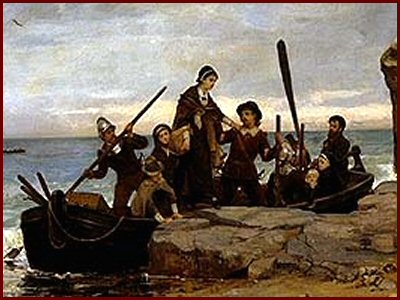
Who issued Green Cards to the Pilgrims?

In 1620, a group of strange newcomers arrived on the shores of North America. They spoke a foreign language and were miserably poor. Desperate and hungry, they robbed the graves of the native-born and stole food to survive during their first year in this new land. Called the Separatists in their home country, most of us know these outcasts as the Pilgrims. Despite their illicit arrival and questionable deeds, today we revere the Separatists — and with good reason.

Unlike the Spaniards who came to this hemisphere to conquer and convert the natives to their faith, the Separatists wanted to form a new society. They sought the freedom to worship denied them in England. They wanted a chance to thrive without an oppressive aristocracy. Their dream of liberty and prosperity became the DNA of today’s vibrant U.S. culture.

But the Separatists were not saints. Their society was egalitarian—as long as you were white. Although the legends say the natives were invited to that first Thanksgiving feast, eventually there would be no place at the table for the land’s dark-skinned populace. By the end of the 1600s, most natives in New England had been wiped out by disease and war. This tragic chapter in U.S. history is also part of the Separatists’ legacy. Even to this day, many in the U.S. profess equality but practice prejudice.

As we pause to give thanks for the blessings of freedom and plenty, let’s not forget that those Separatists we venerate were foreigners who arrived without Green Cards, committed criminal acts, disrespected local customs, and created social upheaval. Yet their industry, faith, and determination made this abundant land flourish.

Nearly 500 years later, some things have not changed.

Raul Ramos y Sanchez

Saturday, November 19, 2011

The danger of derailed dreams


A just-released USC poll shows a disturbing difference between Latinos and Non-Hispanic Whites: 

79% of Latinos favor the recently enacted California Dream Act. Meanwhile, only 30% of Non-Hispanic Whites favor the law which would give undocumented students who have graduated from California high schools equal footing in qualifying for in-state college tuition rates.   

The poll results are troubling for two reasons.

First, it shows the political chasm between Latino and mainstream communities growing wider. Widespread support for laws like Arizona’s infamous SB1070 and similar measures enacted in Georgia, Alabama and on the docket in other states have already been a source of discord that has alienated many Latinos. The lack of support for the California Dream Act, which most Latinos see as a fair and sensible first step toward immigration reform, will only increase the perception that prejudice is the prime motive behind these attitudes.

Second, and perhaps more ominous, is the increasing alienation of the fastest growing age group among the fastest growing ethnic group: Latino youth.

What happens when a generation of intelligent, motivated young people find themselves marginalized and their potential stunted by societal forces? A look around the world – and at history – indicates that a very likely outcome is social upheaval including protests, rioting and even open rebellion. For proof, one only need look at this year’s Arab Spring, the recent riots in England and France, China’s democracy movement culminating in Tiananmen Square, the overthrow of the Shah of Iran, and Castro’s revolution in Cuba. In all of these rebellions and many others, disillusioned young people have the spark and fuel for turmoil.

But I will not simply point the finger at the mainstream community and say “get over your prejudices.” That answer is too simple – and ultimately ineffective.

We in the Latino community must do a better job of framing this debate. Our public message must emphasize the economic benefit of educating the best and the brightest. We all gain when motivated young people are allowed to flower into their full potential. It will mean more prosperous workers paying more in taxes and fueling consumer demand, more entrepreneurs creating jobs and fewer demands on our social services. Xavier University student Bernard Pastor is one example of the exemplary leadership these young people can bring if given the chance. 

In contrast, denying equal opportunities to these young people who have committed no crimes will hurt all of us.

I wrote America Libre and House Divided as a warning to the potential of an ethnic conflict in the United States. The trends were are seeing today make me fear my cautionary tale may be prophetic instead.

Let’s make a smart choice. Let’s choose to help these young people – and also help ourselves. The Dream Act deserves your support.

Raul Ramos y Sanchez

Thursday, November 17, 2011

Alabama discovers bigotry has a price


Bigotry has a price.

This is what the people of Alabama are discovering as the effects begin to sink of its draconian anti-immigrant law, HB-56. Enacted less than two months ago on September 29th, many in Alabama are now having second thoughts about the law proudly dubbed "the nation's harshest" by its authors.

You see, in an effort to root out the wanton and dangerous criminals who are doing honest work without a visa, Alabama's legislators made it a felony to aid these menaces to society in any way. When first introduced, the law was cheered on by 80% of the Alabama electorate. But now that "real Americans" are experiencing the cosequences of HB-56, demands are coming that the law be "tweaked." The reason?

The law demands proof of citizenship or legal residency for virtually every type of government service and transaction. And any government official who does not enforce the law is subject to felony charges. (And we all know how cooperative state bureaucrats are to begin with.)

As a result, everyone in Alabama will be required to "show their papers" not just to get a driver's license but for activities like dog licenses, garbage pickup and flu shots at county health departments. Other activities that might fall under the purview of the law include paying taxes, renting a pavilion at a county park, enrolling children in a Little League team or signing up for a membership at the county swimming pool. Professionals like architects, nurses, hair stylists, plumbers, real estate agents and a host of other professions will have to demonstrate their legal status every time they renew their licenses.

These unintened consequences are really not surprising. When state legislators ride a frenzy of fear and loathing into office and create laws based on emotion rather than reason, the real-world effects of these laws are usually overlooked. Ask the people of Arizona who recently voted out Russell Pearce, the architect of that state's draconian SB-1070.

Even as they rail against "big guvmint" in Washington, the supporters of this law have created possibly the most onerous state government in the nation. And all this because of the heinous threat posed by less than 5% of Alabama's population whose law-breaking is primarily doing the brutally hard work most in the state refuse to do.

Once again, it's clear that bigotry trumps reason -- every time.

Raul Ramos y Sanchez

Wednesday, November 16, 2011

Alabama is once again the site of "outside agitators"

Photo - Dave Martin AP
"Outside agitators." That's what the KKK and their ilk called those who came from other states to  protest legalized racial segregation in Alabama during the early 1960s. The protesters, who were mostly young and educated, arrived determined to overturn the Jim Crow laws that institutionalized second class status for their fellow African Americans.

Fast forward 50 years and history is in re-runs.

Yesterday over 100 demonstrators, many of them Latino college students from outside Alabama, staged a protest at the state capitol. The group came to protest HB-56, a recently-enacted Alabama anti-illegal immigration law which is now considered the nation's harshest.

“We had to come here," said Sonia Guinansaca, a Hunter College student from Harlem who is also an undocumented immigrant from Ecuador. "As the saying goes, injustice anywhere is injustice everywhere,”  Guinansaca told the New York Daily News.

The rising tide of protest has done little to deter lawmakers in other states from proposing similar legislation. Indeed, it seems many politicos see fear and loathing of the undocumented as a rich vein for votes.

Will these punitive laws provoke more protests by young, educated Latinos? That seems very likely. And when one in four children under ten in the U.S. today is a Latino, we may be seeing the tip of a generational iceberg of discontent.

Raul Ramos y Sanchez


Monday, November 14, 2011

In Alabama, "Jim Crow is dead. But his cousins are still alive."

From yesterday's New York Times...


November 13, 2011

On the Rise in Alabama


Alabama’s ruling class has dug in against the storm it caused with the nation’s most oppressive immigration law. Some of the law’s provisions have been blocked in federal court; others won’t take effect until next year. But many Alabamans aren’t waiting for things to get worse or for the uncertain possibility of judicial relief or legislative retreat. They are moving to protect themselves, and summoning the tactics of a civil rights struggle now half a century old.
The law was written to deny immigrants without papers the ability to work or travel, to own or rent a home, to enter contracts of any kind. Fear is causing an exodus as Latinos abandon homes and jobs and crops in the fields. Utilities are preparing to shut off water, power and heat to customers who cannot show the right papers.
Alabama is far from alone in passing a law whose express aim is misery and panic. States are expanding their power to hasten racial exclusion and family disintegration, to make a particular ethnic group of poor people disappear. The new laws come cloaked in talk of law and order; the bigotry beneath them is never acknowledged.
But if there is any place where bigotry does not go unrecognized, it is Alabama.
“It is a fear of folks who are not like us,” said Judge U. W. Clemon, a former state senator and Alabama’s first black federal judge, now retired. “Although the Hispanic population of the state is less than 5 percent, the leaders of the state were hell-bent on removing as much of that 4 percent as possible. And I think they’ve been fairly successful in scaring them out of the state of Alabama.”
There are, of course, significant distinctions between the civil rights movement and the fight for immigrant rights. African-Americans have endured 400 years of oppression, and toppled laws created to deny their equality and to brutalize them. Unauthorized immigrants are a group who arrived by choice, mostly. They are living outside the law, and want in.
Yet to those, like Judge Clemon, a civil rights foot soldier who fought Bull Connor and George Wallace, the common thread between then and now — the threat of racial profiling and the abuse of a cheap, exploited work force — is obvious, as is the racism driving the law.
A sponsor of the legislation, State Senator Scott Beason, chairman of the Rules Committee, was secretly taped by the F.B.I. talking about black residents of Greene County. “They’re aborigines,” he said. He is the lawmaker who urged fellow Republicans to “empty the clip” to stop illegal immigrants.
And, just as in the early days of the civil rights struggle, the oppressed and their advocates are scrambling to respond. Early this month, organizers from Alabama and around the country convened a training session for immigrant leaders in rural Albertville, where chicken plants rely heavily on Latino labor. They went from trailer home to trailer home, signing up volunteers to build immigrant networks that will help people protect one another while fighting for repeal of the law and integrating themselves into the life of their state.
This fledgling movement has been embraced by the N.A.A.C.P., whose leaders in Birmingham met recently with immigrant advocates to stress the need for blacks and Latinos to unite against the law. “Jim Crow is dead,” the Rev. Anthony Alann Johnson told the group, “but his cousins are still alive.”

Friday, November 11, 2011

A Hopeful Counter-current

The ousting of Arizona's self-appointed Demagogue-in-Chief, Russell Pearce, is a hopeful counter-current to the nativist backlash of punitive laws like those enacted in Arizona, Alabama, Georgia and underway in other states.

Pearce was the architect of Arizona's SB1070, a bill which has become a model for regressive forces across the nation. Despite widespread protests that the law condoned racial profiling, polls showed a slight majority of Americans favored the measure. Now, the very constituents who elected Pearce have voted him out. Is this a sign of a change in attitude?

More likely, the voters in Pearce's district have grown weary of a heavy-handed politician whose methods alienated many and whose policies brought an economic backlash as many groups boycotted Arizona over Pearce's nativist legislative agenda. And perhaps that is the object lesson in this development.

Economic pressure may be a more powerful force for change than moral suasion.

Raul Ramos y Sanchez

Sunday, November 6, 2011

Florida policy subverts the 14th Amendment and adds to troubled future

The 14th Amendment to the U.S. constitution states that anyone born on U.S. soil is a citizen, a right which many nativists have sought to overturn for the children of undocumented immigrants. While most of these challenges have come through congress, the state of Florida enacted a policy in 2009 that subverts a law that has stood for over 140 years. Put most simply, Florida denies U.S. citizens born to undocumented parents their legal right to pay in-state tuition rates -- even when these young people have met residency requirements including graduating from state high schools.

Now, five students born in the U.S. to undocumented parents are suing the state. In a USA Today article Michael Hethmon, director of the Immigration Reform Law Institute states: "As the question of illegal immigration remains unresolved, it becomes an obvious flashpoint and you'll see issues like this coming up repeatedly in the coming years."

Those “coming years” will forge a generation of young Latinos for whom prejudice will seem as commonplace as smart phones. In less than 15 years, one in four young people entering their volatile late teens will be Latinos. If we see a continuation of the implicit discrimination of nativist excesses like this Florida policy and the harsh laws already in place in Arizona, Alabama, Georgia and other states, we can expect a troubled future.

As my previous essay makes clear, history shows we are approaching the conditions to create a generation of political activists – or even cadres of revolutionaries.

Raul Ramos y Sanchez

Thursday, November 3, 2011

Occupy movement could be a glimpse into future Latino turmoil

As I watch the Occupy movement make national headlines, I see the foreshadowing of another potential political upheaval on the horizon – one that will put Latinos at the center of the turmoil. Let me explain why. 
The Occupy phenomenon spreading across the U.S. underscores an often-ignored fact about political movements: Revolutions are rarely instigated by the downtrodden. They are usually created by affluent, educated young people.

Examine political upheavals present and past and the trend is inescapable. This year’s Arab Spring… China’s democracy movement culminating in Tiananmen Square… the overthrow of the Shah of Iran… Castro’s revolution in Cuba… In all of these diverse societies, and many others, the rebellions were led by disaffected young people motivated more by ideology more than personal need. Fact is, the poor are usually too concerned with survival to worry about abstract notions like justice and equality. My personal history bears testament to this insight. 

My father was a young man with roots in Cuba's working class, the first of his family to attend college. The education his parents worked so hard to provide for him opened my father’s eyes to the inequity and corruption of Cuban society during the reign of strongman Fulgencio Batista. Ironically, my father’s role in Castro’s revolution led to his divorce from my mother and brought me to the United States.

How does all this connect with Latinos? I think by now you may be getting the picture.

One of every four children under age five in the U.S. today is Hispanic according to the Census Bureau. By the time this cohort reaches their late teens, most will be fluent in English and well steeped in U.S. ideals. Many will have grown up seeing their parents struggle to make a living in a nation that tells them anything is possible. If present trends continue, these young people will also reach their teens in a political climate that puts all Latinos in the crosshairs thanks to a backlash against illegal immigration – and the thinly veiled racism that movement has engendered.

Will these young Latinos reach their volatile late teens meekly accepting their fate? Or will they follow a pattern seen in scores of other cultures and lead a rebellion? One thing is certain. We will not prevent this turmoil with repressive laws that alienate Latinos like those adopted by Arizona, Alabama and other states.

Illegal immigration is an issue that conservative politicians are using to pander votes from the ignorant, the fearful and the bigoted. But this short term political gain may have long range consequences. The Occupy movement may one day be seen as the harbinger of a much more turbulent future.

Raul Ramos y Sanchez